
periods and clots
Periods and clots: what they may mean and when to seek care

What can period clots mean?
Period clots can occur during heavier days, and small clots alone do not establish a medical problem. Clot appearance is one detail to notice, not a diagnosis. The more useful picture includes how often the clots appear, how long you bleed, how heavy the flow becomes, what other symptoms you have, and whether bleeding affects your daily life.
Small clots may occur during heavier period days. Larger clots, especially when they happen repeatedly, are a reason to discuss your bleeding with a doctor. Period clots can range from dark red to brownish and from jelly-like to firmer. Their color and texture can vary with blood flow and clotting factors, so appearance alone does not identify the cause.
ACOG defines heavy menstrual bleeding by how much bleeding affects your physical, social, emotional, or material quality of life, not only by the number of pads, tampons, or clots. That means a pattern deserves attention even if you cannot measure the blood loss or describe every clot precisely.
Start with three questions:
- Are the clots small and occasional, or large and repeated?
- Are you bleeding longer or more heavily than your usual pattern?
- Are tiredness, weakness, dizziness, shortness of breath, pain, or missed activities part of the same pattern?
Your answers can help you decide whether to keep a record, arrange an OB-GYN visit, or seek prompt medical attention.
When does clotting become heavy bleeding?
Heavy menstrual bleeding becomes more likely when bleeding is prolonged, unusually heavy, or disruptive, rather than because of one isolated clot. ACOG focuses on the effect bleeding has on your quality of life.
You may not know the amount of blood you lose, and you do not need to measure it before asking for care. Look for practical signs instead. If bleeding keeps you from work, school, exercise, sleep, or normal plans, that effect matters even when the clot pattern is hard to describe.
Different organizations use different ways to describe heavy menstrual bleeding. ACOG emphasizes daily life, while the CDC and RANZCOG provide time, flow, and clot-size examples. These descriptions can guide your decision, but they do not replace an evaluation.
RANZCOG lists several signs associated with heavy menstrual bleeding, including:
- Passing clots larger than a 50-cent coin
- Changing a pad or tampon every hour
- Bleeding through clothing
- Needing a towel or large maternity pad to sleep
- Waking most nights to change menstrual protection
- Bleeding for more than 8 days
- Losing more than 80 mL of blood
You may have heavy menstrual bleeding without every sign on this list. A recurring pattern, a clear change from your usual period, or an effect on daily life is enough reason to arrange an OB-GYN evaluation. You can describe the signs you have without trying to fit yourself into every threshold.
Heavy bleeding can lower iron levels and red blood cells. You may notice unusual tiredness, weakness, dizziness, shortness of breath, or chest pain. These symptoms add useful context to the bleeding pattern and should be included when you contact a clinician.
If you are sleeping poorly, missing work or school, reducing activity, or changing plans because of your period, record that impact even when the bleeding is not constant.
Which changes should prompt an OB-GYN visit?
Changes in clot size, frequency, bleeding length, or daily impact should prompt an OB-GYN visit when they recur or are clearly different from your usual pattern. Larger clots that happen repeatedly deserve discussion, particularly when bleeding lasts more than 7 or 8 days, requires hourly changes, or affects sleep, work, school, or clothing.
Arrange an evaluation if you notice that your periods are becoming harder to manage, even if you are unsure whether the blood loss meets a specific threshold. An OB-GYN can consider the whole pattern instead of relying on one clot or one day of bleeding.
Write down whether the change happened once or across several cycles. Include the first and last day of bleeding, the heaviest days, how often you changed menstrual protection, and whether clots appeared on specific days. That information gives your OB-GYN a clearer starting point.
Bleeding between periods, irregular bleeding, or a major change in cycle timing also belongs in the conversation. A gynecologic evaluation may use a speculum exam to view the cervix when irregular or between-period bleeding is present. Possible causes of heavy menstrual bleeding include changes in ovulation, conditions within the uterus, medicines, bleeding disorders, pregnancy-related problems, and other gynecologic conditions.
Do not wait for the pattern to become easy to explain. Bring the details you have and describe what changed. If you have only noticed the change once but it was pronounced, include that event when you arrange care.
That exam answers a narrower question than the rest of the evaluation. By viewing the cervix, the clinician may look for findings such as a cervical polyp, a fibroid protruding through the cervical canal, or another cervical problem; the exam may also lead to additional testing. A finding in the cervix would not by itself explain every cause of heavy bleeding, because causes can involve ovulation, the uterus, medicines, blood disorders, or pregnancy-related problems. Tell the OB-GYN whether bleeding occurs between periods so that detail is part of the evaluation.
Which symptoms need more urgent attention?
Do not treat them as a minor detail while you wait to see whether the next period is different.
Bleeding that requires a pad or tampon change every hour, continues through clothing, or lasts more than 8 days also needs prompt clinical attention. RANZCOG lists these patterns as signs associated with heavy menstrual bleeding.
When you contact a clinician, state the most time-sensitive details first: how often you are changing protection, how long the bleeding has lasted, whether you feel dizzy or short of breath, and whether you have chest pain or marked weakness.
ACOG also recommends that adolescents with heavy menstrual bleeding be assessed for anemia, hormone-related ovulation problems, and bleeding disorders. When a bleeding disorder is suspected, an OB-GYN should coordinate evaluation with a hematologist.
The exact urgency depends on your symptoms and condition. Keep a record if you can, but do not delay contact while trying to complete it.
What conditions can cause heavy periods and clots?
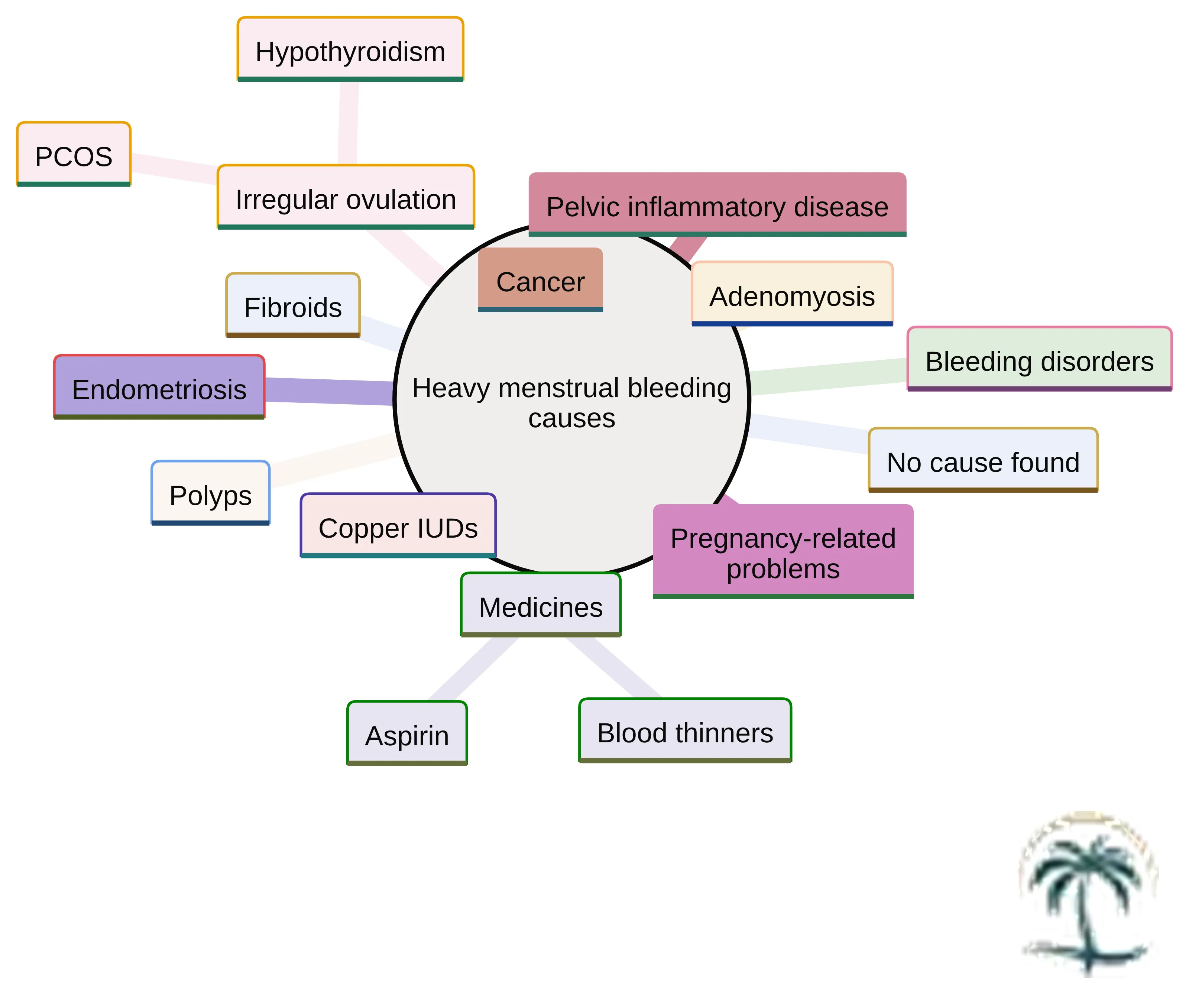
Possible causes of heavy menstrual bleeding include fibroids, polyps, adenomyosis, irregular ovulation, bleeding disorders, some medicines, copper IUDs, endometriosis, pregnancy-related problems, pelvic inflammatory disease, and—less commonly—cancer. Sometimes no cause is found.
These possibilities do not mean that a clot identifies a specific condition. The same visible symptom can occur with different causes, and the pattern around the bleeding helps guide the evaluation. Your OB-GYN will need information about cycle timing, flow, other symptoms, medicines, contraception, and pregnancy possibility to decide which causes need attention.
If you have pain, bleeding between periods, a new cycle change, or symptoms that affect daily life, include those details rather than focusing only on clot size. They help describe the wider pattern.
To make this list easier to discuss, group possible causes by the kind of information that may point toward them. Fibroids, polyps, and adenomyosis are changes within the uterus. Irregular ovulation is another pathway and may occur with PCOS, hypothyroidism, puberty, or perimenopause. Bleeding disorders, blood thinners, and aspirin relate to clotting or medicines, while a copper IUD is a contraception detail. Pregnancy-related problems and pelvic inflammatory disease are other possibilities. This grouping organizes questions for an OB-GYN; it does not tell you which group explains your clots.
Blood thinners and aspirin can contribute to heavy menstrual bleeding. A copper IUD can also make bleeding heavier, especially during its first year of use. Do not stop a prescribed medicine or remove contraception on your own because of bleeding. Tell your clinician what you take and when the bleeding pattern changed so the treatment plan can account for it.
Include over-the-counter aspirin as well as prescribed medicines in your list. The timing matters: note whether the heavier bleeding began after a medicine or contraception change, without assuming that timing proves the cause.
Not finding an obvious cause at the first visit does not make the bleeding unimportant. ACOG notes that sometimes no cause is found, while its guidance for adolescents emphasizes checking for anemia, endocrine problems that affect ovulation, and bleeding disorders when heavy menstrual bleeding is present. Keep describing the pattern if it continues or affects your life.
An unexplained pattern still gives you a reason to track dates, flow, symptoms, and cycle changes. Those details can guide what your OB-GYN considers next.
How do fibroids, endometriosis, and PCOS fit?
Fibroids, endometriosis, and PCOS can fit into different pathways that lead to heavy menstrual bleeding. ACOG lists fibroids and endometriosis among possible causes of heavy bleeding. ACOG also explains that irregular ovulation can allow the uterine lining to become too thick, and irregular ovulation can occur with PCOS.
That distinction matters. PCOS is not identified by the presence of a clot. Its relevance here is that it can be associated with irregular ovulation, which may contribute to heavier bleeding. Fibroids and endometriosis are separate gynecologic conditions that may also be considered when bleeding is heavy.
Adenomyosis and polyps are other conditions ACOG lists as possible causes. You do not need to sort these conditions out from the appearance of your period. Record the pattern and arrange an OB-GYN evaluation when the bleeding is repeated, prolonged, disruptive, or accompanied by concerning symptoms.
Irregular ovulation can occur with PCOS or hypothyroidism and is also common during puberty and perimenopause. If your cycle timing has changed along with heavier bleeding, tell your clinician when the change began and whether your periods now arrive earlier, later, or less predictably.
The same information can help distinguish a one-cycle change from a continuing pattern. Mention pelvic symptoms, bleeding between periods, medicines, a copper IUD, and any possibility of pregnancy because each can affect which causes are considered.
A clot does not tell you whether fibroids, endometriosis, PCOS, or another gynecologic condition is involved. That question belongs in an OB-GYN evaluation.
What should you record before seeing an OB-GYN?
Before seeing an OB-GYN, record the bleeding pattern you can remember; you do not need a perfect log. A short record helps you explain what changed and gives the visit a clear starting point. Include these details:
- The date bleeding began and ended
- The number of days that were heavy
- How often you changed a pad, tampon, or other menstrual product
- Whether you bled through clothing or needed to change protection during sleep
- How often clots appeared and whether they were small or larger than usual
- Any bleeding between periods
- Pain, weakness, dizziness, unusual tiredness, shortness of breath, or chest pain
- Changes in cycle timing, including irregular or skipped periods
- Medicines, aspirin, blood thinners, or a copper IUD
- A possible pregnancy or any recent change that may matter
Use the words that fit your experience. You can note “changed every hour” or “bled through clothes” instead of estimating blood volume.
Before the visit, separate your usual pattern from the new one. Write one sentence about what a typical period is like for you, then note what changed: longer bleeding, heavier days, repeated clots, new pain, or a change in cycle timing. If you do not know exact dates or amounts, say that plainly and use comparisons such as “more often than usual” or “changed every hour.” The goal is not a perfect measurement. It is a clear account of the change and its effect on daily life. Bring the record even if the next period looks different, because the comparison can help the clinician understand the pattern.
Your symptom record should include how bleeding affects daily life. ACOG uses quality-of-life impact when defining heavy menstrual bleeding, and heavy bleeding can be linked with lower iron levels and red blood cells. Note missed work or school, poor sleep, reduced activity, or difficulty completing usual tasks.
If you are an adolescent, include any history that may help an OB-GYN consider anemia, hormone-related ovulation problems, or a bleeding disorder. If the bleeding becomes heavy while you are still collecting information, seek prompt medical attention rather than waiting until the record is complete.
Bring a medication and contraception list, including when each item started. Blood thinners, aspirin, and copper IUDs can affect menstrual bleeding. Do not change a prescribed medicine based only on your notes; give the information to a clinician so the next step can be chosen with the full context.
You can also write down questions before the visit. For example, ask which part of the bleeding pattern matters most, whether your symptoms need testing, and what changes should prompt you to contact the office again.
What happens during an OB-GYN evaluation?
An OB-GYN evaluation may include questions about your bleeding pattern and a pelvic examination. Depending on your symptoms, the pelvic examination can include a speculum exam to view the cervix and a bimanual exam to assess pelvic structures. A speculum exam can help the clinician examine the cervix when bleeding is irregular or occurs between periods.
You can use your notes to explain the timing, flow, clot pattern, pain, cycle changes, and symptoms such as dizziness or shortness of breath. Tell the clinician about medicines, contraception, and possible pregnancy. Those details help place the bleeding in context rather than treating the clot as a diagnosis.
The examination selected for you depends on your symptoms and the clinician’s assessment. Ask what each part of the evaluation is intended to assess if you are unsure.
Different parts of the visit answer different questions. Your history shows when the change began, whether it repeats, and how it affects daily life. A speculum exam focuses on the cervix, while a bimanual exam assesses pelvic structures. This is why a clot’s size or color is not enough to decide what examination is useful. If irregular or between-period bleeding is part of the story, mention it before the examination, since it can change which findings the clinician needs to check. If the clinician recommends another assessment, ask which symptom or pattern led to it.
For adolescents with heavy menstrual bleeding, ACOG recommends assessment for anemia from blood loss, endocrine disorders that cause irregular ovulation, and bleeding disorders. When a bleeding disorder is suspected, an OB-GYN should coordinate laboratory evaluation and medical management with a hematologist. Heavy bleeding may also lower iron levels and red blood cells, so symptoms such as weakness, dizziness, shortness of breath, or chest pain matter during the assessment.
Our planned gynecology and conditions care will include a 45-minute first visit and same-day ultrasound. An ultrasound may be part of the evaluation when it fits your symptoms and the clinician’s plan; it does not turn a clot’s appearance into a diagnosis. The appropriate examination or imaging depends on your situation.
The timing matters: Vireo Women’s Health plans to open in 2027, so the 45-minute first visit and same-day ultrasound describe planned future care, not an appointment available now. For a current concern, keep using the decision path in this article and bring the same bleeding record to the medical professional you choose. The planned service detail does not change how you describe your symptoms now or when you seek care.
How can a Miami woman choose the next step?
You can choose the next step by matching the bleeding pattern and your symptoms to one of three paths. No single clot can make the decision for you.
Keep a record and monitor the pattern when clots are small, occur during heavier days, and are not part of prolonged, unusually heavy, or disruptive bleeding. Note the next cycle and arrange care if the pattern changes or continues.
Arrange an OB-GYN visit when larger clots recur, bleeding lasts more than 7 or 8 days, you change menstrual protection every hour, bleed through clothing, lose sleep, or find that bleeding affects daily life. Bring your dates, flow notes, symptoms, medicines, contraception, and cycle changes.
If you live in Miami, you can use the same decision path: record a mild and occasional pattern, arrange an OB-GYN visit for repeated or disruptive changes, and seek prompt attention for heavy bleeding with concerning symptoms. The purpose is not to label yourself with fibroids, endometriosis, PCOS, or another condition. It is to identify the level of care that fits the pattern and give the clinician useful information for the evaluation.
A pelvic examination, possible ultrasound, and any other assessment should be selected in light of your symptoms. Keep the boundary clear: a clot can signal that you need more information, but it cannot tell you which condition is present.
If you are unsure which path fits, choose the safer action of contacting a medical professional and describe the bleeding and symptoms you are experiencing.
Plan your next step with Vireo Women's Health
Menstrual clots are best judged in context. Track how often they occur, how long and heavily you bleed, whether your daily life is affected, and whether you have symptoms such as dizziness, weakness, shortness of breath, or chest pain. Use that information to decide between monitoring, arranging an OB-GYN visit, and seeking prompt medical attention.
If you are in Miami and seeking future gynecologic care for menstrual bleeding concerns, we plan to open Vireo Women’s Health in 2027. Appointments are not available before the practice opens. A qualified professional must decide what your symptoms mean and which evaluation or treatment is appropriate.
What should I know about periods, clots, and future care?
What does it mean if I have large blood clots during my period?
Large blood clots during your period can indicate a potential issue, especially if they occur frequently. It’s important to monitor the size and frequency of clots, as well as any accompanying symptoms like prolonged bleeding or significant changes in your menstrual pattern. Discussing these changes with an OB-GYN can help determine if further evaluation is needed.
When should I seek medical attention for menstrual bleeding?
You should seek medical attention if you experience heavy bleeding that requires changing a pad or tampon every hour, lasts more than 8 days, or is accompanied by symptoms like chest pain, shortness of breath, dizziness, or marked weakness.
What should I record before visiting an OB-GYN about my menstrual bleeding?
Before visiting an OB-GYN, record details such as the dates of your bleeding, the heaviness of your flow, how often you change menstrual products, any clots you notice, and any symptoms like pain or fatigue. This information will help your clinician understand your situation better.
How can I prepare for my first visit to Vireo Women's Health?
To prepare for your first visit to Vireo Women’s Health, gather information about your menstrual history, any medications you are taking, and a record of your symptoms. This will help the clinician provide personalized care tailored to your needs.
Living with this?
We treat this in Miami.
Our clinicians are board-certified in obstetrics and gynecology. Reading about a condition only goes so far — an exam, and the right imaging, tell you which of these actually applies to you.